
Industry Seat - #001
In Conversation with Naledi Khabo
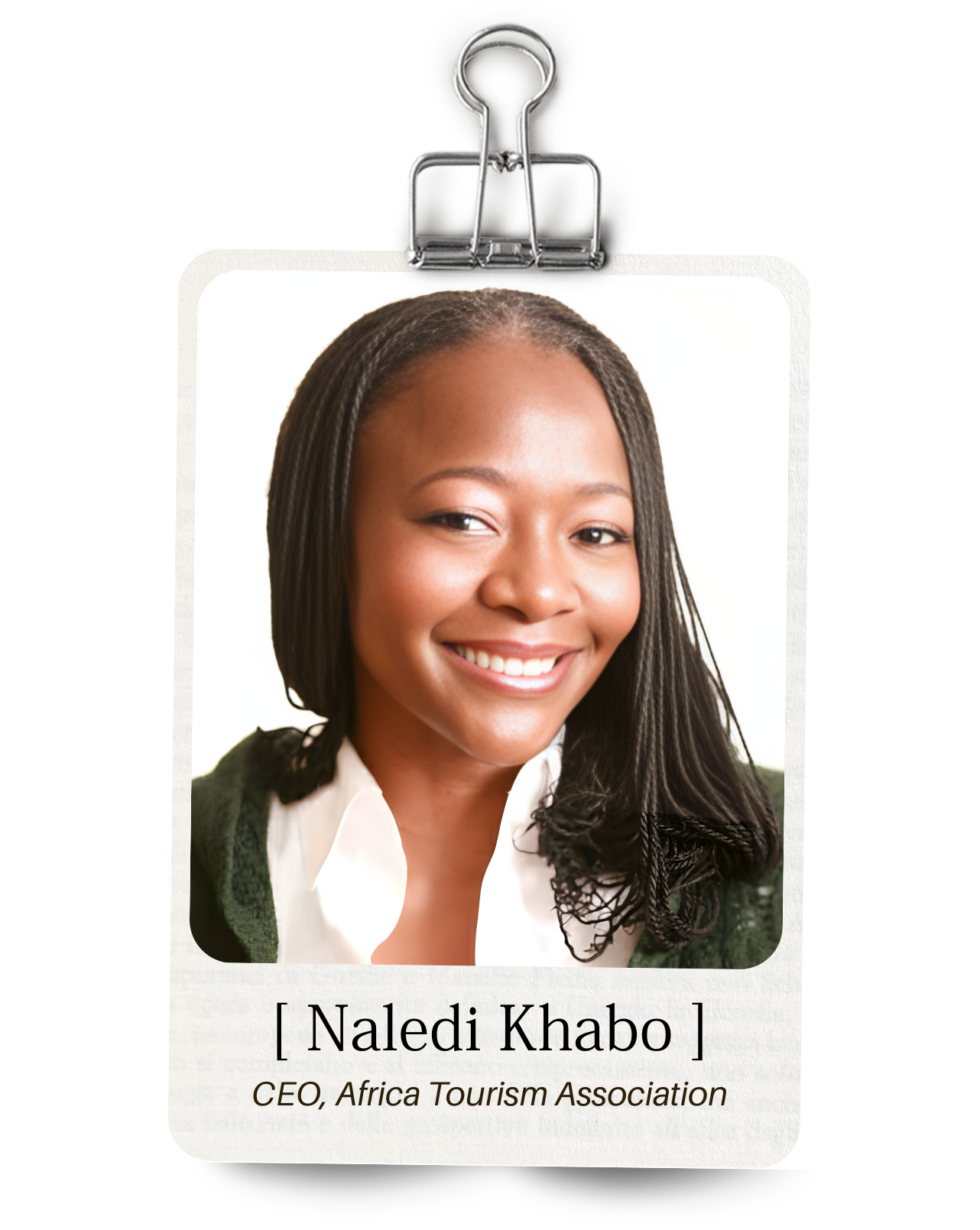
There's a particular kind of clarity that comes from distance. Not the kind that makes you forget where you're from, but the kind that sharpens your understanding of it. Naledi Khabo carries that clarity. As CEO of the Africa Tourism Association, she speaks about the continent with the precision of someone who has watched it from multiple vantage points, global platforms, local communities, boardrooms, and street corners, and refuses to accept a single, flattened narrative.
Her work doesn't start with destinations. It starts with a question: Who gets to tell the story? And more importantly, who benefits when that story travels?
What began as a mission to reposition an industry body has grown into something more expansive. Through platforms like WorldToAfrica and Passport to Africa, Naledi has built what she calls "narrative ecosystems", deliberate, layered, emotionally resonant frameworks that position Africa not as a backdrop for adventure, but as a living, breathing, evolving center of culture, creativity, and economic power.
She doesn't speak in buzzwords. She speaks in systems. Brand. Technology. Partnerships. Community agency. Economic infrastructure. These aren't abstract ideals for her, they're the scaffolding that holds up the future she's building.
In this conversation, conducted via email, Naledi unpacks the work that doesn't always make it into glossy travel campaigns: the visa regimes that still suffocate movement, the communities left out of strategic planning, the myths that cling to the continent like dust on old colonial maps. But she also offers something rarer, optimism grounded in evidence. A belief that the next generation of African creators, entrepreneurs, and policymakers are already rewriting the rules.
This isn't a conversation about tourism as escape. It's about tourism as transformation. As ownership. As infrastructure for a different kind of future.
For people meeting you for the first time, how do you usually describe what you do, and what inspired the journey that became the Africa Tourism Association and platforms like WorldToAfrica and Passport to Africa?
I usually describe my work as leading a mission-driven organisation focused on promoting tourism to and within Africa while reimagining Africa's role in the global tourism economy. As CEO of the Africa Tourism Association, my focus is to advance growth, storytelling, and investment across the continent by building partnerships and platforms that make tourism more inclusive, innovative, and sustainable.
When I stepped into the role in 2020, I inherited an association with a long history, and my first priority was to reposition ATA as a mission-first organisation, not just an industry body but a catalyst for change. That expansion led to the creation of strategic pillars that now guide our work. In addition to B2B engagement, our pillars cover diaspora engagement, meetings and events, sports, creative industries, and investment.
WorldToAfrica emerged during that transition as a tagline, and we revamped our Instagram profile, designed to shift perception and spark inspiration. It's intentionally more cultural and aspirational, sharing the creativity, lifestyle, and spirit that shape Africa's modern identity. The goal was to build emotional resonance and a strong visual narrative.
Passport to Africa, both a website and Instagram platform, was born directly from demand, travelers constantly asking, Where should I go? What should I see? By curating and creating content, we're bridging the gap between curiosity and accessible, trustworthy information. Passport to Africa is an entry point for discovery that highlights destinations, experiences, creators, and local businesses. It complements the work of ATA by turning interest into action, making it easier for travelers to engage with African destinations on a more informed level.
All our platforms are connected by the same mission: to make Africa more visible, more accessible, and more valued.
Every big idea starts with seeing something others didn't. What did you notice early on about how Africa was being represented in travel, and what made you want to change that story?
Even before I entered the industry, I was quite aware that the dominant narrative about African travel was centered around a narrow set of images: safari and charity, mostly. Meanwhile, the majority of travelers' real emotional experience of a destination, anywhere in the world, begins with culture, food, fashion, film, art, music, nightlife, and sports. That's how people connect with places, how identity travels globally, and how tourism becomes transformative instead of transactional. And Africa's cultural and creative capital was almost entirely absent from mainstream travel messaging.
I didn't set out to replace the safari story. I wanted to complete it. To amplify and build narrative ecosystems that reflected Africa as a dynamic, multi-layered destination. This wasn't just a branding opportunity, it was economic, creative, and emotional.
The travel narratives didn't include the energy of Afrobeats from Lagos, the culinary scenes in Dakar and Cape Town, the global fashion movement emerging in Kigali, the gallery scene in Marrakech, or the nightlife in Kampala. We weren't acknowledging the massive influence of Nollywood, the cultural magnitude of festivals like Afrofuture, or sporting events including AFCON and the Basketball Africa League.
Closing this narrative gap was not just a cultural necessity, it was an economic one. Culture is one of tourism's strongest economic drivers. Because when people connect with culture, they travel more, they invest, they collaborate, they return. Globally, cultural and creative sectors represent trillions in economic value, drive employment, and fuel one of the fastest-growing segments of tourism. When Africa positions culture at the centre of its tourism strategy, it not only changes perceptions but expands markets, stimulates local economies, and increases the sector's contribution to GDP. It's a strategy that turns storytelling into economic infrastructure.
You often talk about community-centred tourism. Can you share a moment when feedback from a local community made you rethink how you design an experience or tell a story?
There wasn't one moment, but rather a pattern that became impossible to ignore. Across different destinations, I found that communities consistently had to respond to tourism initiatives after decisions were made, rather than being invited into the strategy from the beginning. The industry often speaks about "community engagement," but operationally, it tends to be reactive, seeking validation or feedback after the product is already designed.
What became clear to me is that if we're going to advocate for community-centred tourism, then communities cannot simply be beneficiaries or storytellers at the end of the process. They have to be co-architects of the vision. They should inform what gets built, how it's experienced, how value is distributed, and how culture is represented, before a product is packaged or a story is told.
I've had multiple instances where communities expressed that misalignment, not because they rejected tourism, but because they wanted agency. They wanted clarity on who benefits, how cultural knowledge is protected, and how tourism aligns with their long-term priorities.
Community involvement has to happen at the level of strategy, planning, and governance. So rather than asking, "How do we incorporate community feedback?" we need to ask, "How do we build processes where communities help imagine outcomes before we start executing?" If we want immersive tourism that's culturally grounded and economically meaningful, community voices need to be integrated at the level where direction is set.
From your work across Africa, what still makes it hard for people, travellers, creators, even locals, to move freely across borders? And what small changes do you think would make the biggest difference?
Two barriers that consistently stand out are visa complexity and poor intra-African connectivity. It's often easier and less expensive to travel to Europe from many African cities than from one African country to another. That reality shapes everything, from tourism flows to trade, cultural exchange, and regional collaboration.
Visa regimes remain cumbersome, unpredictable, and costly. Creators and digital nomads struggle with short-term work permits, and Africans traveling within their own continent face inconsistent border policies and bureaucratic barriers. Streamlining visa processes and offering visa-free access for Africans traveling within Africa would unlock demand, talent mobility, and economic exchange, resulting in a quantifiable positive impact on tourism.
In terms of air connectivity, increasing affordable routes would make intra-Africa travel more accessible and attractive. Affordable, strategic routes between regional hubs could reshape the economics of movement. These changes would unleash economic opportunity, giving way to increased tourism, increased business travel, more creative exchange, and ultimately a stronger contribution from tourism to national and regional GDP.
You've spent years challenging outdated ideas about Africa. What's one myth about the continent you wish the global travel world would finally let go of, and what would open up if they did?
I would like to retire the idea that Africa is difficult to navigate, risky, or defined by poverty and political instability. These narratives overshadow the reality that Africa is home to highly developed tourism markets, modern infrastructure, world-class hospitality, and some of the most innovative cities and cultural ecosystems anywhere.
These perceptions don't just distort how travelers see the continent, they also distort how investors assess risk, how policymakers set priorities. Africa is a dynamic travel market with a growing middle class, a youth-driven innovation economy, and global influence across culture, fashion, music, film, sport, and design. Dispelling these myths will make space for a more accurate and expansive narrative, where Africa is seen not as a challenge to overcome, but as a continent of possibility, complexity, and modernity worth exploring and engaging.
You've built brands that blend storytelling, technology, and on-the-ground partnerships. How do you think the future of African tourism will balance these three forces, brand, partnerships, and tech, to drive real scale?
Brand and storytelling create desire, technology removes friction, and partnerships deliver on-the-ground value. To achieve meaningful scale, these forces have to operate as a coordinated system, because none of them work in isolation.
On the storytelling side, we need destinations, creators, media, and voices across the diaspora to build narratives that shift perception and generate demand for a wider set of destinations and experiences. Storytelling has to function as market activation, to drive bookings, investment, and cultural curiosity.
Technology shouldn't replace human experiences, it should unlock them. Tools that standardize information, aggregate supply, and enable cross-border digital infrastructure will be essential. Platforms that map supply, connect travelers to vetted experiences, facilitate cross-border payments, elevate local creators, and help SMEs access global markets are the operating systems we need.
Partnerships that bring together governments, private operators, airlines, investors, community organisations, and creative entrepreneurs will drive scale. The sector needs alignment around regulatory frameworks, incentives, financing, and infrastructure development that support mobility, innovation, and sustainability.
Scale will come from ecosystem architecture, building systems that enable participation, reduce friction, and keep economic value circulating locally. The future of African tourism will be defined by those who treat brand, technology, and partnerships not as tactics, but as the required infrastructure to power the industry.
Finally, when you think about the future of African tourism, what gives you the most optimism right now?
There's a clear surge of interest in the continent from travellers, investors, creators, and diaspora communities who are seeking deeper cultural connection, authentic experiences, and opportunities beyond traditional tourism models. Destinations are recognising this shift and becoming more proactive in identifying new audiences, promoting new products, and developing offerings that speak to culture, wellness, gastronomy, adventure, design, and nightlife, not just heritage or wildlife. This diversification reflects a more mature industry that understands the future of travel is experiential and will be driven by identity and cultural expression.
Africa's cultural influence is shaping global culture at an extraordinary pace. African music, fashion, food, film, sport, design, and digital creativity have become mainstream, aspirational forces shaping trends and consumer behavior worldwide. The diaspora is playing a particularly powerful role in this, acting as both cultural ambassadors and economic catalysts, driving demand, investment, and storytelling across borders.
What makes me most optimistic is that this momentum is being led by a new generation of African creators, entrepreneurs, technologists, and policymakers who see tourism as a platform for ownership, job creation, and narrative power. They're building brands, digital platforms, culinary experiences, festivals, tour companies, art spaces, and adventure products that are globally competitive and locally grounded.
Africa has the talent, the creativity, and the infrastructure to turn culture into economic value and tourism into an engine for inclusive growth. And with global curiosity, diaspora engagement, and continental innovation converging at the same moment, the opportunity is not just to grow the industry, but to shape an entirely new model of tourism, driven by culture and African identity.
The conversation continues, even after the interview ends. Because with people like Naledi, the work is never really about answering questions. It's about asking better ones.