
Industry Seat - #002
In Conversation with Kayla Doris
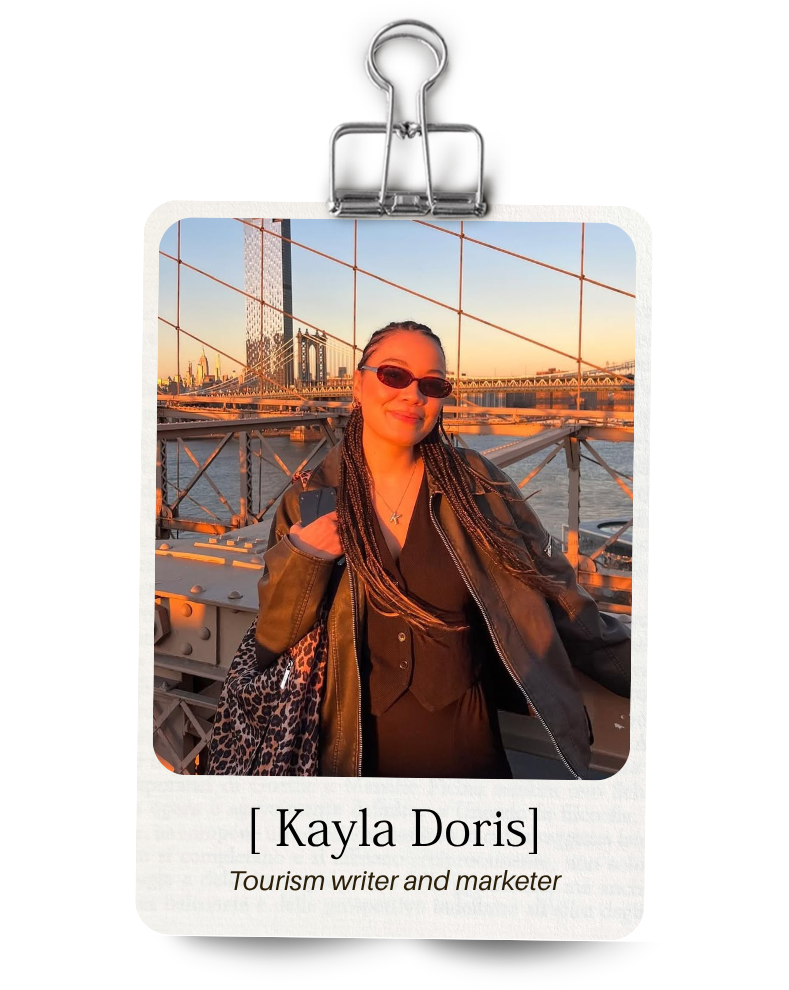
There's a discomfort that sits at the heart of Kayla Doris's work. Not the kind that makes you look away, but the kind that makes you lean in closer, questioning things you thought you understood. She writes about tourism the way someone might write about a city they both love and fear losing, with intimacy and urgency, aware that every story told is also a story withheld, and every destination marketed is also a community altered.
Her newsletter, Kayla Doris is Away, doesn't promise easy answers or guilt-free getaways. It offers something rarer: honesty. The kind that asks uncomfortable questions about all-inclusive resorts that lock locals out of their own beaches, about who profits when we travel, about the gap between what tourism promises and what it actually delivers. She doesn't approach travel writing as an invitation to escape. She approaches it as an invitation to see clearly.
Coming to travel from outside the traditional industry, Kayla carries the perspective of someone who wasn't raised inside the myth. She didn't grow up believing that tourism was inherently good, that it automatically connected people across cultures, that it lifted communities simply by existing. She learned those narratives later, and by the time she did, she'd already seen enough to question them.
Her work exists in the spaces between what's marketed and what's real. It's informed by her background in creative scenes, by her understanding of fashion's reckoning with fast consumption, and by a belief that tourism needs a similar awakening. Not just about carbon footprints and plastic straws, but about power, ownership, and who gets to shape the story of a place.
In this conversation, conducted via email, Kayla unpacks what responsible tourism actually means beyond the eco-lodge branding, why creativity might be one of tourism's most undervalued tools, and what it would take for the industry to tell stories that don't erase the people who live them.
This isn't a manifesto. It's a invitation to think differently. To travel slower. To ask better questions.For readers encountering your work for the first time, how do you introduce yourself and the mission that shapes your approach to travel, storytelling, and community-centred tourism?
I'm a writer and marketer who specialises in responsible tourism. In my day-to-day work as a freelancer, I support a consultancy that develops sustainable frameworks for destinations, tourism boards, and travel enterprises, and I also develop content for responsible travel businesses. In my spare time, I write a newsletter,Kayla Doris is Away, where I alternate between co lumns exploring the realities of modern-day tourism, reflections from my own travels, and interviews that spotlight the stories often left out of mainstream tourism narratives. I would say my overall mission is to challenge conventional ideas of responsible tourism and to make it seem more engaging, more exciting for travelers.
Before we go further, how do you personally define responsible travel? What principles sit at the heart of it, and what common misconceptions do you think still need to be clarified?
I think the biggest misconception is that responsible travel is solely about the environment. When people hear sustainable travel or responsible travel, they probably think of nature, reducing their plastic, tracking their carbon footprint, flying less, or expensive eco-lodges. I genuinely think that it's doing more harm than good for responsible tourism to be branded this way. It isn't exciting for travelers (truthfully, nobody wants to think about being "responsible" when they're traveling), but it means that people are missing the full picture.
This is an example I use a lot when describing this to people. In Jamaica, one of the main issues with tourism is the foreign-owned, all-inclusive resorts that retain much of the profits from tourism, while keeping guests from engaging with local businesses and culture, and privatizing the coastline so that local people cannot access their own beaches. If all of those resorts had sustainability certifications and eco-friendly practices, should this still be described as responsible tourism? Of course not.
There's been a brilliant movement from sustainable fashion creators and educators who have made us all aware of the fast fashion system and its ties with capitalism and consumerism, and I think that's needed for tourism. To recognize it as an industry that's growing unsustainably due to governments and corporations that want as much growth and profits as possible, while the benefits to local communities are limited (and the environments are negatively impacted too). For me, responsible tourism is about recognizing those systems and thinking of "fast travel" the same way we do with fast fashion.
An alternative to fast fashion is avoiding items that are mass-produced by global corporations and supporting slow fashion, crafts, and small, local and sustainable creators. This would look the same in travel so that power is redirected to local communities, but also practiced with a slower, more intentional, and more culturally-immersive approach. There's a clarity in the comparison. Fast fashion. Fast travel. Both built on extraction. Both promising more than they deliver. Both needing the same kind of reckoning.
You've said your journey into travel was a bit unconventional. How has coming from outside the traditional industry shaped the way you think about responsible tourism and the kinds of projects you're drawn to?
I wasn't able to travel when I was growing up due to being from a low-income family. I didn't go on a plane until I was 20. So I felt like I grew up believing all of the myths about tourism, that it's good for local economies, that it connects locals and travelers, that you learn about other cultures, and so on. Once I started traveling, I was really disappointed with the realities. I'm not sure if I would have questioned the usual way of traveling, had I always grown up doing that.
I would also say that I'm a creative person who has always loved learning about cultural movements and scenes around the world, which has really shaped my approach to responsible travel. I consider: How can tourism support local creative scenes? How might travelers use local creative work as a way to connect more deeply with the culture of a place? Can creativity also be used as a means to challenge outdated ideas of destinations?
For instance, getting to know about Bangkok's creative scene changed my perception of it as a "backpackers' destination" solely for partying, tuk-tuks, and temples. It's the kind of perspective that only comes from standing outside first. Seeing the promise before seeing the practice. And then carrying that gap, that disappointment, as fuel.A major part of your work involves replacing outdated, narrow ideas about destinations with narratives that are current, nuanced, and rooted in lived realities. Can you share a project where you felt this shift happened meaningfully, what changed in how the destination was perceived, and what changed on the ground?
I try to do this whenever I'm writing travel guides, however genuinely shifting perceptions of a destination is a huge task that takes a lot of work from various organizations on the ground and not something that can happen just from writing.
Although it isn't something I was involved in, I spoke with the team from Kingston Creative when I was working on a Jamaica guide, and I think they're a great example of shifting narratives about a place. They are a non-profit organization that has used art to transform Downtown Kingston and challenge the perception of Kingston being a dangerous place that isn't worth visiting. Another example of how creativity is important for destinations.
There's humility in that answer. An acknowledgment that one person's writing can't undo decades of narrative. But also a recognition that the work still matters, that every guide written with care, every story told with nuance, is part of something larger.
You often emphasise that travel should create real value for the communities that host travelers. In practical terms, what does genuine community benefit look like from your perspective?
It would look like:
Genuinely good jobs that are paid well, with stable benefits and opportunities to grow. I remember being really surprised when I learned that tourism can actually be a poverty trap for people in the informal sector.
Tourism is adding more value than it's subtracting. If someone is making money from tourism, but they are losing access to their land and their culture is slowly being erased or their neighborhood is becoming too expensive to live in, that doesn't look like a genuine community benefit.
A situation where the local community is in power, through ownership or a role in the decision-making process, so they have control over their narrative, their land, and their culture.
Simple on paper. Radical in practice. Because it requires dismantling the very structures that tourism has been built on.
You often engage with issues like racial equity, cultural preservation, and the ethics of travel storytelling. From your experience, what's one blind spot travel brands still have, and what's a good first step toward doing better?
I would love to see more travel brands covering the diversity of destinations. I want to know about the Surinamese community in Amsterdam, and Afro-French culture, and the history of Chinese-Jamaicans. There are so many stories that still aren't being told, which baffles me.
The wish list is specific. Not vague calls for diversity, but actual communities, actual histories. The kind of stories that don't fit neatly into existing marketing categories, and are all the more essential because of it.
Looking ahead to 2030, if you were helping shape the next chapter of travel narratives, what would you want at the center of that story, and what roles should brands, storytellers, and travelers play in making it real?
I would love to see more diverse and cultural stories. I would like more stories featuring local people who have shaped their community at the center, rather than influencers or "trendy creatives." For instance, Don Letts in London or Dapper Dan in Harlem (highly recommend reading his autobiography). I would like stories that champion the small family-run businesses that don't have the budget for marketing resources or stylish interiors, alongside social enterprises and community and cultural groups that help to shape the place's identity.
It's a vision that refuses the easy aesthetic. The Instagram-ready storefront. The photogenic moment. It asks instead for depth. For commitment. For the kind of storytelling that requires more than a long weekend and a decent camera.
The conversation doesn't end here. It extends into every choice a traveler makes, every story a brand tells, every community that decides whether or not to open its doors. Kayla's work is a reminder that tourism isn't neutral. It never has been. But it could be different. It could be slower, more intentional, more honest about who benefits and who bears the cost.
The question isn't whether we travel. It's how we travel. And who we listen to when we do.